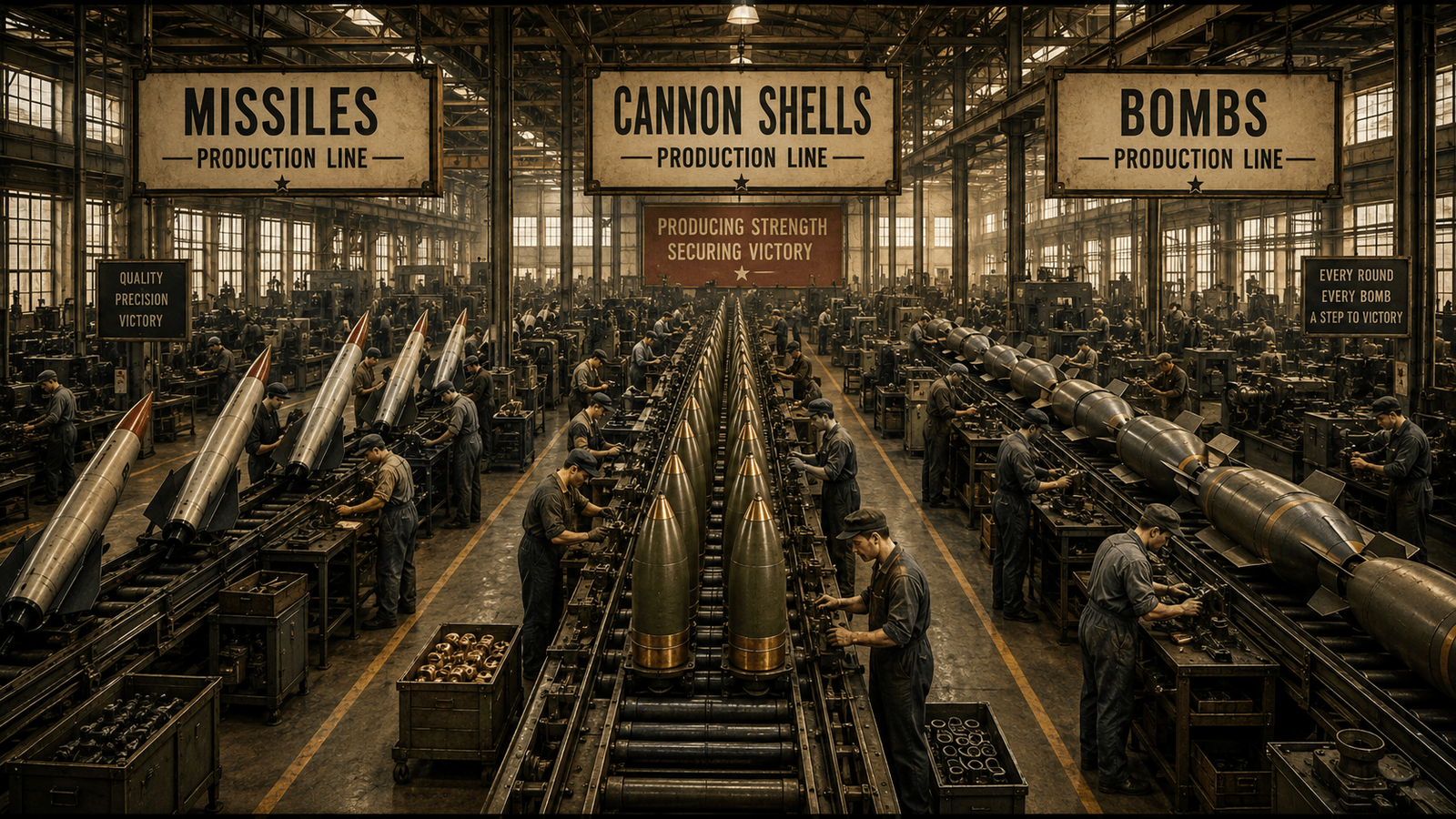
A paradox at the heart of modern war
Modern warfare has created a paradox. Weapons have become extraordinarily sophisticated, precise, and expensive, yet wars are simultaneously consuming them at rates the peacetime defence industry was never designed to sustain. The experience of Ukraine, Israel, and the United States has exposed a fundamental truth: a nation’s military power is not determined only by what it possesses in its inventory. It is determined by what its industrial base can replace while the war is still being fought.
A nation’s military power is not what it holds in stock. It is what its factories can still produce after the stock is gone.
This distinction between stockpile capacity and war-production capacity is becoming one of the most important determinants of national security, and it is precisely why the world is now racing to build factories, expand production lines, secure raw materials, qualify second suppliers, and stitch together international partnerships for ammunition and missile production. India has just taken an important step in this direction.
The ammunition paradox
A military can accumulate enormous stocks during peacetime, but ammunition has a peculiar characteristic: it is consumed, not merely deployed. A tank may survive a war for years, a fighter aircraft may fly hundreds of missions, but a missile, artillery shell, interceptor, or rocket is usually gone after one engagement. That creates a fundamentally different industrial problem. Suppose a country possesses 100,000 artillery shells and its factories can manufacture 5,000 a month. That sounds reassuring until a major conflict consumes 20,000 rounds every month, at which point the inventory depletes four times faster than the industrial base can replenish it.
The problem becomes even more severe with missiles and air-defence interceptors, where a single unit can cost hundreds of thousands or millions of dollars. But the industrial question is never really the price of the missile. It is how many can be manufactured next month, the month after that, and for the next three years.
The United States discovered the problem the hard way
The United States possesses arguably the world’s most sophisticated defence-industrial ecosystem, yet the Ukraine war exposed significant weaknesses in its ability to rapidly replenish certain classes of munitions. The U.S. Army had originally aimed to raise 155 mm artillery-shell production to 100,000 rounds a month. A Pentagon Inspector General assessment instead found production running at only about 36,000 rounds a month as of March 2026.
The fascinating part is why. The limiting factor was not the ability to fill shells with explosives; it was the ability to manufacture the metal projectile itself.
The capacity of a weapons system is determined by the capacity of its slowest critical component.
The United States has since invested billions of dollars in expanding its munitions industrial base. Between 2022 and the subsequent expansion programme, monthly 155 mm projectile capacity rose from roughly 14,400 to 40,000, while GMLRS production climbed from about 833 to 1,167 a month. Even these numbers reveal the difficulty of the task: doubling production is one thing, but multiplying it tenfold is an entirely different industrial problem.
The hidden bottleneck beneath the factory floor
A missile assembly plant may look impressive, but behind it sits an enormous industrial pyramid: airframe structures, precision machining, electronics, seekers, guidance systems, actuators, batteries, warheads, explosives, solid rocket motors, propellants, sensors, specialised materials, test equipment, software, and packaging, each with its own web of suppliers. The critical bottleneck may therefore be a Tier-3 supplier that nobody sees.
The United States has discovered this particularly clearly in solid rocket motors, essential to a wide range of missiles and interceptors yet historically produced by a small handful of firms. The American defence-industrial system is now trying to bring additional companies into that ecosystem, modernise production, invest directly in suppliers, and lock in long-term procurement arrangements. The lesson is profound: a prime contractor cannot surge production if its sub-contractors cannot surge alongside it.
Israel: building capacity while fighting the war
Israel is perhaps the clearest example of a nation forced to treat defence manufacturing as an element of national survival. Its industrial ecosystem, built around companies such as Rafael, Israel Aerospace Industries, and Elbit, is supported by an unusually close relationship between government, military, and industry, yet even Israel has found that sustained high-intensity conflict stretches production capacity to its limits.
During its recent wars, Israel dramatically expanded domestic ammunition production. The Israeli Ministry of Defense reported a new ammunition factory, a national raw-materials plant, four new production lines, and the expansion of four existing lines, together doubling ground-munitions production capacity since the start of the war. Israel also reported the production and delivery of more than 40,000 air munitions during the same period, and accelerated production of both the Arrow missile-defence interceptor and the Iron Dome interceptor.
What is most interesting about the Israeli case is not simply that it bought more weapons. It built industrial redundancy and expanded manufacturing capacity while the war was still being fought.
Even Israel needs America
Even a technologically advanced defence-industrial power such as Israel does not operate in isolation. The Iron Dome ecosystem is a striking example of industrial partnership between Israel and the United States, with the U.S. Missile Defense Agency embedded in the development and production of Israel’s multi-layered missile-defence architecture. A new facility in Arkansas now manufactures Tamir interceptors for Iron Dome and its American derivative, SkyHunter. Production capacity itself is becoming an element of alliance architecture.
Europe discovers the same problem
Europe spent decades optimising its defence industry for relatively small peacetime orders, and the Ukraine war exposed the consequences. The European industrial base had quietly lost manufacturing capacity, skilled labour, explosives and propellant production, specialised machinery, supplier diversity, and surge capability. European annual ammunition production capacity was estimated at around 300,000 artillery rounds in 2022; by the end of 2025 the target had risen to roughly 2 million rounds a year. Rheinmetall alone increased its annual 155 mm production capacity nearly tenfold from pre-war levels, reaching around 700,000 rounds a year, with plans to approach a million.
But again, the problem was never simply building a factory. Europe’s real constraints run through explosives, propellants, chemicals, steel, machine tools, energy, skilled manpower, regulatory approval, and supply chains. Even nitrocellulose, an obscure industrial chemical to most observers, has become a strategic consideration because of Europe’s dependence on external sources.
Russia demonstrates the other model
Russia presents an interesting counter-example, its defence-industrial base structured around large-scale, state-controlled production and mobilisation. The Ukraine war drove a dramatic increase in Russian ammunition output. Estonian intelligence estimates put Russian artillery ammunition production and refurbishment at roughly 400,000 rounds in 2021, rising to around 7 million rounds by 2025, with domestic output supplemented by supplies from North Korea and Iran. Russia has also invested in explosives production, including a new facility at the Biysk Oleum Plant intended to produce around 6,000 tonnes of high explosives annually, potentially enough for more than a million artillery rounds.
The lesson from Russia is not simply that it produces large quantities. It is that wartime production requires industrial depth that extends well beyond the weapons factory itself.
The real arms race is moving underground
The next phase of the global arms race may not be visible in new fighter aircraft or tanks. It will increasingly be visible in factories: for explosives, propellants, rocket motors, warheads, artillery shells, missile bodies, guidance electronics, seekers, batteries, actuators, precision components, specialised alloys, and energetic materials. The world is discovering that a modern military can possess superb weapons and still carry a dangerous vulnerability: insufficient industrial depth.
There is also a broader shift under way in how nations pursue defence technology. Where the earlier equation ran simply from technology to weapons, the emerging one runs from technology through factory, supply chain, workforce, and financing to long-term orders. The United States is considering production and maintenance of advanced missiles outside its own territory. European nations are establishing multinational production arrangements. NATO is attempting to standardise ammunition so that multiple countries can manufacture interoperable rounds, and in July 2026, nine NATO members agreed to develop a common 155 mm munition framework intended to improve interchangeability and accelerate production. A related multinational initiative is exploring joint development of deep-precision strike capabilities.
The future defence industry will increasingly be distributed rather than national. One country designs, another builds the motor, a third manufactures the electronics, a fourth assembles, a fifth supplies the warhead. The objective is not merely lower cost. It is resilience and surge capacity.
And this brings us to India
India’s recent decision to open DRDO-developed conventional missile technologies to qualified private Indian companies is therefore far more significant than it might first appear. On 25 August 2026, Defence Minister Rajnath Singh approved the transfer of DRDO-developed technology for all conventional missile systems to qualified domestic companies for production, with private firms now competing alongside public-sector entities for manufacturing rights. This marks a real departure from the older model, in which a government R&D organisation developed the technology and a narrow set of government-owned production organisations remained the principal manufacturers.
India is effectively saying that the technology has already been developed, and now the industrial capacity must be built to manufacture it at scale. That is precisely the right question, but technology transfer alone will not answer it.
Technology transfer is only step one
Handing a company a technology package does not automatically create a production capability. There is a real difference between technology transfer and technology-to-production transfer. The first hands over drawings, specifications, processes, and know-how. The second creates tooling, machinery, qualified suppliers, process control, test infrastructure, skilled manpower, production engineering, quality systems, inventory, raw-material security, acceptance procedures, maintenance capability, working capital, production planning, and, above all, surge capacity. That gap between paperwork and production is where India’s opportunity, and its challenge, actually lies.
Why India should not build one factory for one missile
This is perhaps the most important principle of all. India should resist the temptation to simply build one missile in one factory through one manufacturer. Instead, it needs a distributed manufacturing architecture, one in which a missile ecosystem might see one company build the airframe, another the propulsion system, a third the electronics, a fourth the actuators, a fifth the warheads, a sixth handle final assembly, and a seventh provide testing, with multiple firms qualified for the most critical components. This creates something far more valuable than raw capacity. It creates industrial redundancy: if one factory is damaged, delayed, or overloaded, another can take its place.
India’s own ammunition-indigenisation programme already recognises this principle. The Indian Army has stated that one of its objectives is to establish at least two sources for each type of ammunition while developing critical technologies and manufacturing infrastructure. Of the Army’s 175 in-service ammunition variants, approximately 159, or about 91 percent, have already been indigenised, though the number of qualified suppliers still varies considerably from item to item.
Single Source
Efficient in peacetime, but a single point of failure the moment a crisis begins.
Dual Source
Resilient. A second qualified supplier turns a vulnerability into a buffer.
Multi Source
Capable of surge. Only a genuinely distributed base can multiply output under pressure.
India already has evidence the model can work
The private sector is no longer merely a supplier of minor components. In January 2026, the government highlighted the expansion of private-sector ammunition manufacturing, including a fully automated facility for 30 mm ammunition at Solar Defence and Aerospace, alongside an explicit intention to widen private-sector participation in both manufacturing and R&D. India’s defence production reached approximately ₹1.78 lakh crore in FY 2025-26, with private industry accounting for about 24 percent of that output, against a stated government target of ₹3 lakh crore in annual defence production by 2029. The ecosystem is clearly moving. The open question is whether it can move fast enough.
Build for surge, not merely for peacetime demand
This is where India’s defence manufacturing philosophy needs to evolve. The governing question should not be how many missiles can be manufactured annually. It should be how quickly production can be multiplied if the strategic situation deteriorates, and that is a fundamentally different industrial-design problem. A factory built for a thousand missiles a year may not be capable of producing five thousand, but a factory deliberately designed around modular production lines, common components, spare tooling, alternate suppliers, and pre-qualified manpower may be capable of exactly that. Surge capacity has to be engineered into the factory from day one, not bolted on after a crisis begins.
Five things India should do
Different missiles and munitions should share manufacturing technologies wherever possible, from CNC machining and composite structures to electronics, actuators, telemetry, batteries, warhead technologies, testing, and packaging. Commonality across programmes creates economies of scale that no single-product factory can match on its own.
The next Indian defence-manufacturing champion may not be the company that builds the missile at all. It may be the company that manufactures the rocket motor casing, the actuator, the guidance module, the fuze, the battery, or the energetic material inside it, which is precisely why government incentives need to reach down to Tier-2 and Tier-3 suppliers rather than stopping at the prime contractor. The United States is already moving in this direction, its own experience having shown that production bottlenecks tend to sit well below the visible assembly line.
No private company will invest hundreds of crores in a specialised defence production line simply because the government might place an order someday. The economics require visibility, and long-term procurement contracts, framework agreements, and minimum-order commitments can provide exactly that confidence. Private capital needs predictable demand before it will commit to capacity nobody has asked for yet.
A cold production line exists only on paper, or has been shut down entirely. A warm line produces at a low rate during peacetime but can rapidly expand during a crisis. India should deliberately maintain warm capacity for its most critical ammunition and missile families. The cost of doing so looks unnecessary during peace. The cost of discovering the capacity does not exist during war is exponentially higher.
Finally, India cannot become genuinely ammunition-independent while it remains dependent on external sources for critical energetics, chemicals, specialised metals, or electronic components. The missile factory is only the tip of the iceberg; the real strategic industrial base begins several tiers below it, in minerals, chemicals, and energetic materials, long before it ever reaches components, subassemblies, weapons, testing, and deployment. Every critical dependency deserves to be mapped, every single-source dependency needs an alternative, and every strategic material needs either an assured stockpile or a domestic production route.
The ultimate metric: days to surge
Perhaps India should introduce a new metric into defence-industrial planning altogether: days to surge. If a missile production line currently produces a hundred units a month, how many days would it take to reach five hundred? What actually stands in the way, whether machinery, raw material, workers, testing capacity, rocket motors, electronics, government inspection regimes, supplier capacity, or working capital? That analysis needs to be conducted before a crisis, not after one begins.
The future belongs to industrial ecosystems
The wars of the twentieth century demonstrated the importance of industrial capacity. The wars of the twenty-first are rediscovering it. The United States has enormous technological superiority, yet is still expanding factories. Israel has extraordinary technological depth, yet is still building ammunition plants. Europe possesses some of the world’s finest defence companies, yet is still rebuilding its artillery production base. Russia has dramatically expanded ammunition output, yet has simultaneously had to seek external supplies and invest in new explosives capacity of its own. And NATO is increasingly pursuing multinational production precisely because no single national industrial base can efficiently provide everything a prolonged conflict demands.
India now has the chance to learn from all of them at once.
From Make in India to Make Enough in India
The objective of defence self-reliance should not simply be whether India can manufacture something. The more important question is whether India can manufacture enough of it, whether it can double that output when required, and whether it can sustain that higher output for years rather than months. That is the real difference between manufacturing capability and war-winning industrial capacity.
The decision to transfer conventional missile technologies to private Indian companies is not merely another policy reform. It can become the foundation of something considerably larger, if India uses it to build distributed manufacturing ecosystems, competitive suppliers, redundant supply chains, indigenous energetics, scalable production lines, and long-term industrial partnerships.
The arsenal is what a nation has today. The industrial base is what a nation can still produce tomorrow. In a prolonged war, tomorrow may matter more.
The next strategic contest may not be decided by who has the most advanced missile. It may be decided by who can keep producing that missile after the first thousand have already been fired.