The Pattern Behind Every Revolution
Every era of warfare has been defined by a technological revolution. Gunpowder changed battlefields forever. Aircraft altered the very geometry of war. Radar transformed air defence, nuclear weapons redefined deterrence, stealth challenged conventional air superiority, and precision-guided munitions revolutionised strike operations. Artificial Intelligence may well become the next transformational leap.
Yet history teaches us something equally important: technology has rarely failed because of a lack of ambition. It has far more often been undermined by overconfidence.
The Dunning–Kruger Problem in Uniform
Psychologists David Dunning and Justin Kruger described a cognitive bias in which people with limited knowledge tend to overestimate their competence, while genuine experts often express greater caution because they understand the complexity of the subject. Although the Dunning–Kruger effect has become an internet cliché, its implications for defence and aerospace are profound. Few professions punish misplaced confidence as swiftly or as ruthlessly as military technology.
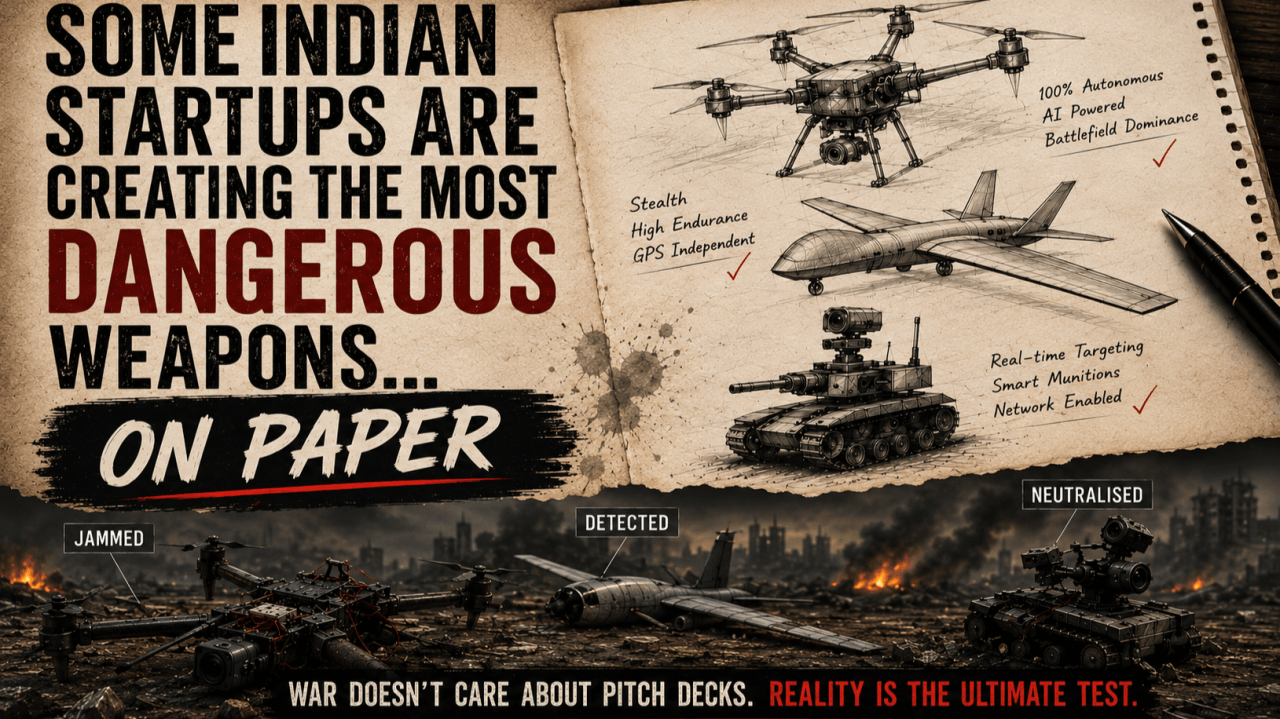
Today’s defence ecosystem is overflowing with extraordinary claims. Scroll through LinkedIn for a few minutes and you will encounter startups that have supposedly mastered fully autonomous drones, AI capable of identifying every target under all conditions, navigation systems that function effortlessly in GPS-denied environments, counter-UAS systems that neutralise every threat, and algorithms that promise to compress the entire kill chain into seconds. If one were to believe every presentation, decades of painstaking research in aerospace engineering, electronic warfare, radar, communications, control theory and operational doctrine have suddenly become little more than implementation details.
Reality, however, is considerably less forgiving.
A Prototype Is Not a Product
Developing a military capability is about surviving thousands of hours of testing, vibration, extreme temperatures, electromagnetic interference, software anomalies, hardware failures, manufacturing tolerances, battlefield abuse and, above all, a determined adversary actively attempting to defeat your system. The enemy has little interest in marketing brochures.
A prototype is not a product. A successful field trial is not operational capability. An AI model that performs well under controlled conditions is not battlefield autonomy.
Obedience Is Not the Same as Judgment
During my years in the Indian Air Force and later in Defence R&D, I learnt a distinction that has remained with me ever since. Military discipline requires unquestioned obedience to lawful authority. Operational success, however, depends upon something very different: the willingness of authority to listen to expertise.
As a soldier, I accepted authority without hesitation. What I found difficult to accept was authority overriding informed technical advice without understanding the issue at hand. Rank commands obedience; sound decisions require knowledge and judgment.
The Best Leaders Knew What They Did Not Know
The finest commanders and programme leaders I had the privilege of serving under were not those who claimed to possess every answer. They were leaders who understood the limits of their own knowledge. They encouraged disagreement, invited rigorous technical scrutiny and expected subject-matter experts to challenge assumptions whenever the evidence demanded it.
Their authority was never diminished by admitting that someone else knew more about a particular subject. On the contrary, it was strengthened, because their decisions were informed by the best available expertise rather than by rank alone.
Confidence Is Rewarded More Readily Than Competence
Unfortunately, modern defence discourse often rewards confidence more readily than competence. Marketing frequently attracts greater attention than engineering. Buzzwords generate headlines more easily than qualification trials. Sophisticated animations create excitement, whereas reliability testing, certification and systems integration remain largely invisible.
If a social media platform crashes, users become frustrated. If an e-commerce application fails, customers choose another service. When a military radar fails to detect an incoming threat, when an EW system misclassifies a target, or when an autonomous platform makes the wrong decision, the consequences are measured not in market share but in human lives and national security.
Scepticism Is Not Cynicism
For that reason, scepticism is not cynicism. Rigorous questioning is not resistance to innovation. Technical peer review is not bureaucratic obstruction. They are the disciplines that separate engineering from wishful thinking. Every mature defence ecosystem in the world has learnt that difficult questions asked early prevent catastrophic failures later.
The Path Forward
India possesses extraordinary scientific talent, world-class engineers, experienced military professionals and an increasingly capable defence industrial base. There is every reason to be optimistic about the future. But optimism alone has never built a combat-proven capability. Innovation also requires intellectual humility, the confidence to acknowledge uncertainty, the discipline to validate every claim, and the wisdom to recognise that no amount of enthusiasm can alter the laws of physics.
The next breakthrough in Indian defence technology will come from those willing to subject their ideas to relentless technical scrutiny, accept uncomfortable criticism, learn from failure, and let evidence, not ego, lead.
In defence, confidence may win applause. Competence wins wars.