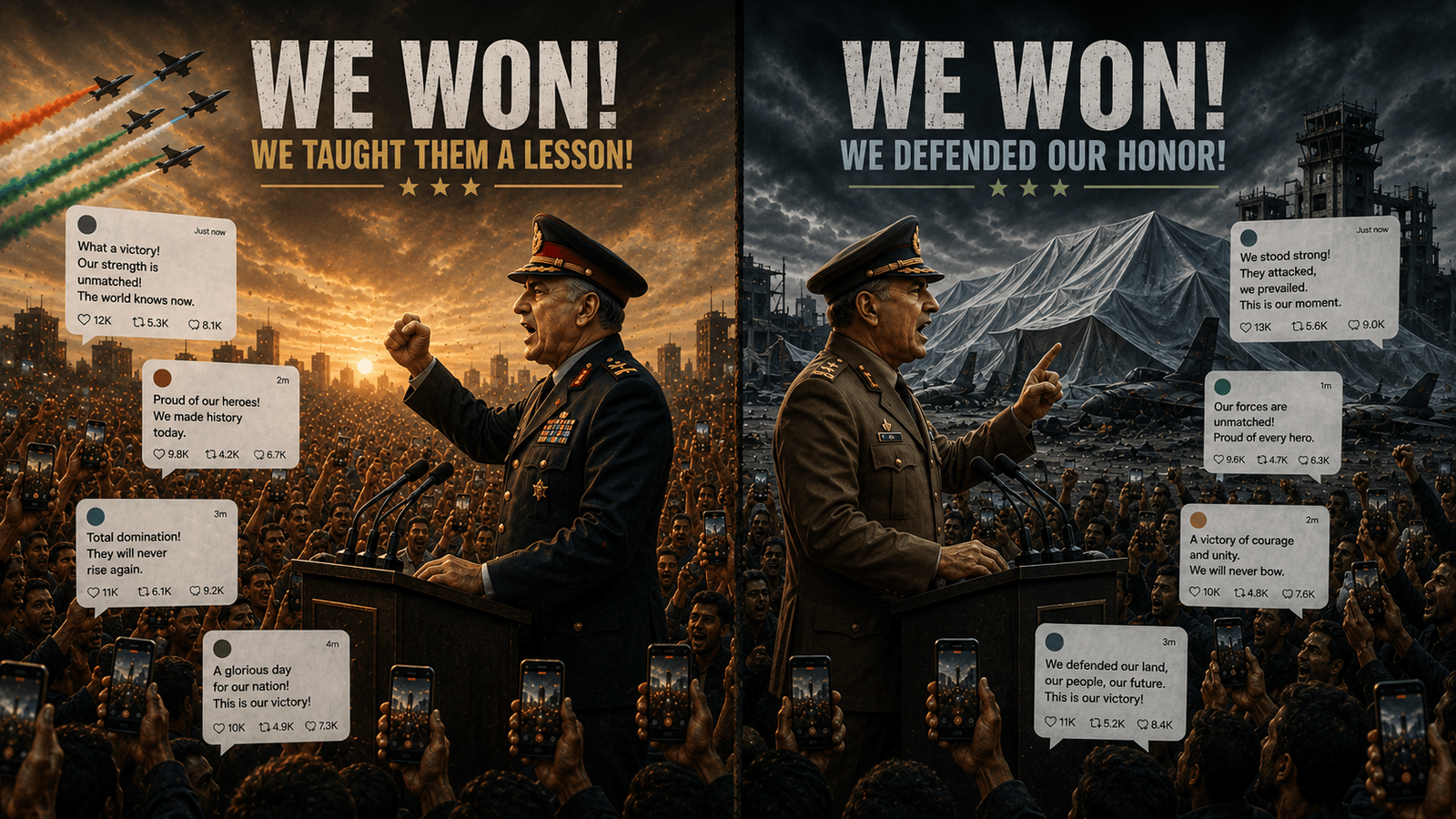
The Premise
Every war begins with a sentence that sounds almost pedagogical: we will teach them a lesson they will never forget. It is a curious phrase for an act of organised violence, borrowed from the schoolroom, not the battlefield. A lesson implies a teacher, a student, a syllabus, and, crucially, an outcome that can be assessed. War offers none of these with any reliability. Yet the metaphor persists across centuries and civilisations because it does something politically indispensable: it converts the ugly, uncertain, and often self-serving decision to use force into an act of moral pedagogy. The aggressor becomes an instructor. The war becomes a curriculum. And the enemy, degraded to the status of a wayward pupil, is assumed to be capable of learning, contrite enough to change, and honest enough to admit the lesson stuck.
None of this is usually true. But the fiction is necessary, because “we are teaching them a lesson” is a far more sellable proposition to a domestic public than “we are gambling with lives to alter a strategic equation whose outcome we cannot predict.”
The Machinery of Escalation
Once the premise is set, the machinery follows a strikingly consistent choreography, regardless of geography or era: mobilisation, the first exchange of fire, the search for escalation dominance, and the slow discovery, usually within days, that the adversary is not, in fact, a passive pupil but an active agent with its own lesson plan. Kargil in 1999, the Six-Day War in 1967, the Falklands in 1982, the Yom Kippur War in 1973: each began with one side certain of a swift, didactic victory. Each ended in a place neither side had quite planned for.
This is the first irony of the “lesson” framing: it assumes a controllable pedagogy in a domain defined by its unpredictability. Clausewitz called this friction, the accumulation of small frictions, miscalculations, and contingencies that separate the war as planned from the war as fought. Modern militaries spend enormous intellectual energy trying to compress this friction through better intelligence, faster OODA loops, and precision weapons. But friction is not merely a technical problem to be engineered away. It is inherent to the clash of two independent wills, each trying to impose its own narrative on the other by force.
The Ceasefire as a Rhetorical Vacuum
Then comes the ceasefire, and this is where the analysis becomes genuinely interesting, because a ceasefire is one of the strangest instruments in statecraft. It is, at its core, an agreement about the cessation of an activity, not an agreement about meaning. Two sides agree to stop shooting. They almost never agree on what the shooting achieved, what it proved, or who won. The ceasefire document is legally and operationally precise about timelines and lines of control; it is almost always silent, deliberately so, on the question of victory. This silence is not an oversight. It is the space into which competing national narratives immediately rush.
Both governments now face an identical political problem: having told their publics that a lesson was being administered, they must now certify that the lesson was learnt, or at least delivered. Domestic audiences do not want ambiguity, they want closure, and closure requires a story with a moral. So each side reaches for the same rhetorical toolkit: military claims are curated for their most favourable data points, ambiguous outcomes are reframed as decisive ones, and the adversary’s own claims are dismissed as propaganda even as one’s own claims are elevated to fact.
This is not necessarily cynical deception in every case. Commanders and political leaders often genuinely believe their own assessments, filtered as those assessments are through incomplete battle-damage data, institutional pride, and a fog that never actually lifts. It just moves indoors, into the debriefing room.
Why Both Sides Can Be Right
Here lies the second irony, and it is the intellectually richest part of this phenomenon: both sides can simultaneously claim victory without either being guilty of outright falsehood, because “victory” in modern limited war is rarely a single, falsifiable proposition. It is a bundle of claims: deterrence restored, red lines established, domestic morale sustained, international sympathy secured, military objectives achieved, political survival ensured. A state needs to win only some of these to declare success to its own public.
It takes maturity and deeper understanding of geopolitical restraint to counter an adversary who manufactures narratives to fool their citizens.
Deterrence Restored
Nation A believes it achieved deterrence because the other side sued for a ceasefire.
Cost Imposed
Nation B believes it achieved deterrence because it absorbed the blow and responded without escalating further.
Both, Simultaneously
Neither claim need be false. War termination does not require a scoreboard, only that each side’s story survives contact with its own electorate.
This is why the crescendo the question describes is not an accident of media excess, it is structurally necessary. The narrative must swell precisely at the moment the actual evidence is thinnest, because that is the moment domestic political capital is most at risk. The loudest declarations of victory in modern conflicts have tended to arrive within hours of the ceasefire, long before battle damage assessments, independent verification, or historical distance could possibly have settled the question. The noise is not covering up an absence of a story, the noise is the story, deployed at the precise moment the actual facts are least available to contradict it.
The Lesson That Was Never Delivered
And so we arrive at the deepest irony of all: the premise, “we will teach them a lesson,” is almost never actually tested, because nobody stays in the classroom long enough to grade the exam. A lesson, properly understood, requires the student to demonstrate changed behaviour over time. But by the time enough time has passed to observe whether behaviour actually changed, the news cycle has moved on, the leaders who declared victory have often moved to other priorities, and the next crisis, sometimes with the same adversary, is already forming.
Ask most militaries privately, away from the press briefing, whether the lesson of the last conflict was actually absorbed by the other side, and the answer is frequently a shrug, sometimes an admission that deterrence was temporary and transactional rather than transformative, and occasionally, most tellingly, an acknowledgment that both sides adjusted their own doctrines more than they altered the adversary’s intentions.
The most durable outcome of most “lessons taught” is not a chastened enemy but a changed self: new procurement priorities, revised rules of engagement, hardened public opinion, and a lower threshold for the next round.
This is the real inheritance of the lesson framework: not deterrence, but recursion. Each side updates its playbook based on the last engagement, and the next crisis begins not from a blank slate but from an accumulated stack of unresolved grievances and half-validated theories of victory. The lesson was never really about the enemy at all. It was about domestic legitimacy, institutional learning, and the psychological need, on both sides, to convert an act of violence with genuinely uncertain outcomes into a story with a clear beginning, middle, and triumphant end.
A Harder Honesty
What would it look like to break this cycle, even partially? Not by abandoning deterrence, states will always need credible ways to signal resolve, but by being more honest, at least in the professional and analytical space away from public messaging, about what force actually achieved versus what was merely claimed. Militaries that conduct rigorous, unsentimental after-action reviews, separating operational fact from political narrative, tend to learn faster than those who mistake their own press releases for lessons learnt.
The uncomfortable truth is that most limited wars end not with one side having taught the other a lesson, but with both sides having taught themselves something narrower and more useful: the current limits of their own capability, resolve, and political tolerance for further escalation. That is a smaller, less cinematic lesson than the one promised at the outset. It is also, usually, the only one that is true.
Underneath the crescendo, the actual pedagogy of war is usually quieter, slower, and considerably more self-directed than either side is prepared to admit while the applause is still going.